4.5/5 - (2 votes)

Latest Success Metrics For Actual CBAP Exam (Updated 500 Questions)

Genuine CBAP Exam Dumps Free Demo Valid QA’s

Q259. A major manufacturer of popular beverages has appointed a local distributor to serve a specific territory. The demand for the beverages has a pronounced seasonal pattern. The distributor performs well overall, but is repeatedly unable to keep up with fulfilling many customer orders during peak demand periods. The distributor’s current delivery capability is stretched to deliver 60 tons of merchandise per day whereas the season’s peak demand periods need a daily delivery capability of up to 100 tons.
The distributor is under pressure to fully meet the year-round market demand in order to stay in business. The distributor’s management wants to identify and consider more cost-effective options as resorting to adding more trucks and drivers would not be economically feasible.
A business analyst (BA) has spent several days observing and measuring the warehouse activities to understand the situation and to gain insights into possible solutions. The delivery workflow is a four-step process: (1) picking the orders and assembling them on trays, (2) bringing the trays to the loading bay, (3) loading the orders into trucks, and (4) delivering the orders to customers. As the following table illustrates, overall performance depends is dependent on five major resources: (1) the workers who pick the orders and load them into trucks, (2) the tallyers who check the orders, (3) the drivers, (4) the trucks, and (5) eight loading bays (LBs).
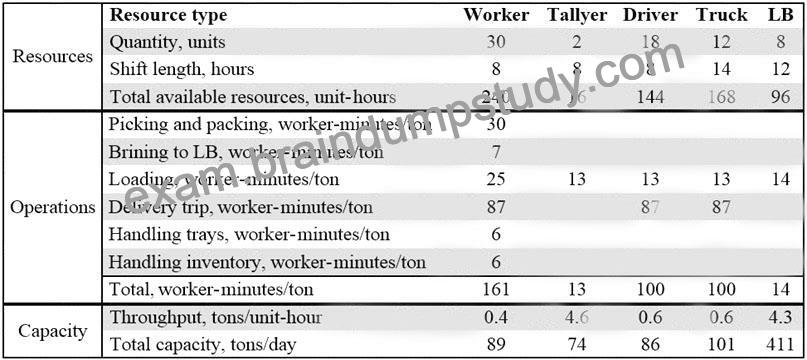
Each truck can only make two trips a day. The BA has noticed that only 30% of trips have their orders available for loading when a truck arrives. Otherwise the truck has to wait one extra hour until the orders are picked and brought to the loading bay.
If trucks are the only constraint, approximately how many hours are lost due to this downtime?


Q260. The objective of a solution implemented was to increase the number of customer calls resolved per hour.
When using basic statistical sampling concepts, what does the business analyst (BA) need to consider?


Q261. Paul is the business analyst for his organization. He is examining a single solution to determine if the solution he and his team have identified carries enough business value to justify its implementation. What business analysis process is Paul performing in this scenario?


Q262. Which of the following involves defining the various threats, determining the extent of vulnerabilities, and devising countermeasures against a possible attack?


Q263. A company wants to launch an existing product in another channel and the business analyst (BA) is starting to perform the stakeholder analysis.

Legend: Influence/Impact 1 to 5 (1 = very limited impact/influence: 5 = very high impact/influence).
Considering the analysis, what values for influence and impact will the BA assign to the marketing?


Q264. Which stakeholder must approve the business analysis approach to ensure that the business analysis approach is compatible with the other project activities?


Q265. A major manufacturer of popular beverages has appointed a local distributor to serve a specific territory. The demand for the beverages has a pronounced seasonal pattern. The distributor performs well overall, but is repeatedly unable to keep up with fulfilling many customer orders during peak demand periods. The distributor’s current delivery capability is stretched to deliver 60 tons of merchandise per day whereas the season’s peak demand periods need a daily delivery capability of up to 100 tons.
The distributor is under pressure to fully meet the year-round market demand in order to stay in business. The distributor’s management wants to identify and consider more cost-effective options as resorting to adding more trucks and drivers would not be economically feasible.
A business analyst (BA) has spent several days observing and measuring the warehouse activities to understand the situation and to gain insights into possible solutions. The delivery workflow is a four-step process: (1) picking the orders and assembling them on trays, (2) bringing the trays to the loading bay, (3) loading the orders into trucks, and (4) delivering the orders to customers. As the following table illustrates, overall performance depends is dependent on five major resources: (1) the workers who pick the orders and load them into trucks, (2) the tallyers who check the orders, (3) the drivers, (4) the trucks, and (5) eight loading bays (LBs).

Preparing a customer order for loading takes about one hour. Upon the BA’s observation, only 30% of trips have their orders available for loading when a truck arrives. This causes a waste of both the truck’s and the driver’s time.
What should the BA recommend to eliminate such waste?


Q266. After having created several prototypes of a new web-based application, a business analyst (BA) would like to meet with the organization’s stakeholders to elicit their perception, ideas, and attitudes about the prototypes.
Which of the following techniques should the BA use?


Q267. Which of the following processes is must at the end of each project phase to determine the completeness of the project work and to gain the customer’s acceptance to move the project forward?


Q268. A business analyst (BA) has completed the prioritization of requirements with various risk-averse stakeholder groups. Several requirements conflict with a regulatory requirement that, if not implemented, will result in a fine from a regulatory body.
What should the BA do?


Q269. Robert is the business analyst for his organization and he’s working with several stakeholders to identify the business need for an opportunity. Robert needs to identify the stakeholder that will be responsible for authorizing the actions needed in order to meet the identified business need.
Which stakeholder does Robert need to identify?


Q270. During a requirements review, the implementation subject matter expert (SME) identified the requirement ‘parsing of data’ that must be implemented before other requirements. The business analyst (BA) has given this requirement high priority.
What factor influenced the prioritization of the requirement?


Q271. Wanda is the business analyst for her organization and she is currently working on the specify and model requirements process. One of the elements of this process is the documentation of the textual requirements.
Wanda must describe the capabilities of the solution, any conditions that must exist for the requirements to operate, and what third component of the textual requirement?


Q272. Which one of the following is the most accurate definition of the solution scope?


Q273. A major manufacturer of popular beverages has appointed a local distributor to serve a specific territory. The demand for the beverages has a pronounced seasonal pattern. The distributor performs well overall, but is repeatedly unable to keep up with fulfilling many customer orders during peak demand periods. The distributor’s current delivery capability is stretched to deliver 60 tons of merchandise per day whereas the season’s peak demand periods need a daily delivery capability of up to 100 tons.
The distributor is under pressure to fully meet the year-round market demand in order to stay in business. The distributor’s management wants to identify and consider more cost-effective options as resorting to adding more trucks and drivers would not be economically feasible.
A business analyst (BA) has spent several days observing and measuring the warehouse activities to understand the situation and to gain insights into possible solutions. The delivery workflow is a four-step process: (1) picking the orders and assembling them on trays, (2) bringing the trays to the loading bay, (3) loading the orders into trucks, and (4) delivering the orders to customers. As the following table illustrates, overall performance depends is dependent on five major resources: (1) the workers who pick the orders and load them into trucks, (2) the tallyers who check the orders, (3) the drivers, (4) the trucks, and (5) eight loading bays (LBs).

If the driver’s average throughput is 0.6 tons/hour, how many hours per day would 15 drivers have to work to deliver 100 tons of merchandise?


CBAP Practice Test Give You First Time Success with 100% Money Back Guarantee!: https://www.braindumpstudy.com/CBAP_braindumps.html


Related Links: myportal.utt.edu.tt www.stes.tyc.edu.tw www.stes.tyc.edu.tw www.stes.tyc.edu.tw myportal.utt.edu.tt www.stes.tyc.edu.tw