4.7/5 - (3 votes)

2023 Realistic MCIA-Level-1 Dumps are Available for Instant Access

Download Exam MCIA-Level-1 Practice Test Questions with 100% Verified Answers

NO.121 Refer to the exhibit.

A Mule application is deployed to a multi-node Mule runtime cluster. The Mule application uses the competing consumer pattern among its cluster replicas to receive JMS messages from a JMS queue. To process each received JMS message, the following steps are performed in a flow:
Step l: The JMS Correlation ID header is read from the received JMS message.
Step 2: The Mule application invokes an idempotent SOAP webservice over HTTPS, passing the JMS Correlation ID as one parameter in the SOAP request.
Step 3: The response from the SOAP webservice also returns the same JMS Correlation ID.
Step 4: The JMS Correlation ID received from the SOAP webservice is validated to be identical to the JMS Correlation ID received in Step 1.
Step 5: The Mule application creates a response JMS message, setting the JMS Correlation ID message header to the validated JMS Correlation ID and publishes that message to a response JMS queue.
Where should the Mule application store the JMS Correlation ID values received in Step 1 and Step 3 so that the validation in Step 4 can be performed, while also making the overall Mule application highly available, fault-tolerant, performant, and maintainable?


NO.122 According to MuleSoft’s IT delivery and operating model, which approach can an organization adopt in order to reduce the frequency of IT project delivery failures?


NO.123 A set of integration Mule applications, some of which expose APIs, are being created to enable a new business process. Various stakeholders may be impacted by this. These stakeholders are a combination of semi-technical users (who understand basic integration terminology and concepts such as JSON and XML) and technically skilled potential consumers of the Mule applications and APIs.
What Is an effective way for the project team responsible for the Mule applications and APIs being built to communicate with these stakeholders using Anypoint Platform and its supplied toolset?


NO.124 Refer to the exhibit.


A business process involves two APIs that interact with each other asynchronously over HTTP. Each API is implemented as a Mule application. API 1 receives the initial HTTP request and invokes API 2 (in a fire and forget fashion) while API 2, upon completion of the processing, calls back into API l to notify about completion of the asynchronous process.
Each API Is deployed to multiple redundant Mule runtimes and a separate load balancer, and is deployed to a separate network zone.
In the network architecture, how must the firewall rules be configured to enable the above Interaction between API 1 and API 2?


NO.125 A Mule application contains a Batch Job with two Batch Steps (Batch_Step_l and Batch_Step_2). A payload with 1000 records is received by the Batch Job.
How many threads are used by the Batch Job to process records, and how does each Batch Step process records within the Batch Job?


NO.126 A corporation has deployed multiple mule applications implementing various public and private API’s to different cloudhub workers. These API’s arc Critical applications that must be highly available and in line with the reliability SLA as defined by stakeholders.
How can API availability (liveliness or readiness) be monitored so that Ops team receives outage notifications?


NO.127 An organization has decided on a cloudhub migration strategy that aims to minimize the organizations own IT resources. Currently, the organizational has all of its Mule applications running on its own premises and uses an premises load balancer that exposes all APIs under the base URL https://api.acme.com As part of the migration strategy, the organization plans to migrate all of its Mule applications and load balancer to cloudhub What is the most straight-forward and cost effective approach to the Mule applications deployment and load balancing that preserves the public URLs?


NO.128 A Mule application is synchronizing customer data between two different database systems.
What is the main benefit of using XA transaction over local transactions to synchronize these two database system?


NO.129 A rale limiting policy has been applied to a soap VI.2 API published in Clondhub. The API implementation catches errors in a global error handler on error propagate in the main flow for HTTP: RETRY_EXHAUSTED with HTTP status set to 429 and any with the HTTP status set to 500.
What is the expected H1TP status when the client exceeds the quota of the API calls?


NO.130 Which Mulesoft feature helps users to delegate their access without sharing sensitive credentials or giving full control of accounts to 3rd parties?


NO.131 An organization has just developed a Mule application that implements a REST API. The mule application will be deployed to a cluster of customer hosted Mule runtimes.
What additional infrastructure component must the customer provide in order to distribute inbound API requests across the Mule runtimes of the cluster?


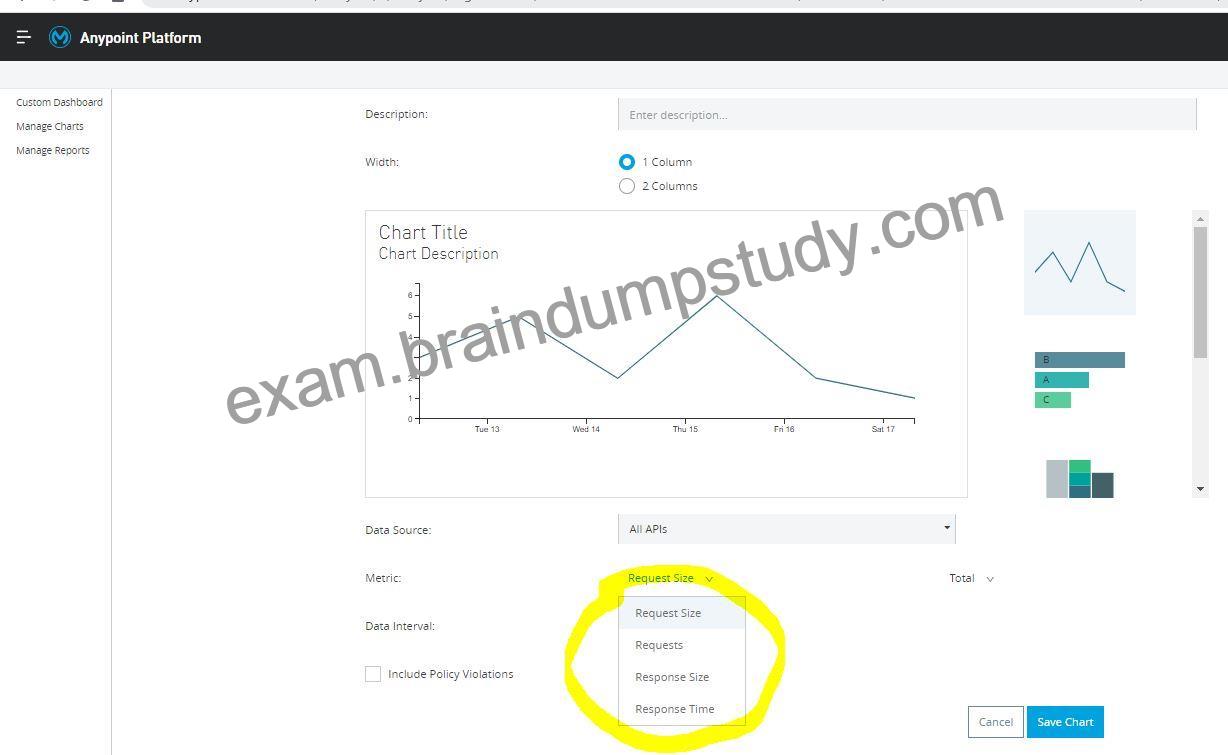
NO.132 What metrics about API invocations are available for visualization in custom charts using Anypoint Analytics?


NO.133 An organization uses a four(4) node customer hosted Mule runtime cluster to host one(1) stateless api implementation. The API is accessed over HTTPS through a load balancer that uses round-robin for load distribution. Each node in the cluster has been sized to be able to accept four(4) times the current number of requests.
Two(2) nodes in the cluster experience a power outage and are no longer available. The load balancer directs the outage and blocks the two unavailable the nodes from receiving further HTTP requests.
What performance-related consequence is guaranteed to happen to average, assuming the remaining cluster nodes are fully operational?


NO.134 An organization will deploy Mule applications to Cloudhub, Business requirements mandate that all application logs be stored ONLY in an external splunk consolidated logging service and NOT in Cloudhub.
In order to most easily store Mule application logs ONLY in Splunk, how must Mule application logging be configured in Runtime Manager, and where should the log4j2 splunk appender be defined?


NO.135 A Mule application is being designed to do the following:
Step 1: Read a SalesOrder message from a JMS queue, where each SalesOrder consists of a header and a list of SalesOrderLineltems.
Step 2: Insert the SalesOrder header and each SalesOrderLineltem into different tables in an RDBMS.
Step 3: Insert the SalesOrder header and the sum of the prices of all its SalesOrderLineltems into a table In a different RDBMS.
No SalesOrder message can be lost and the consistency of all SalesOrder-related information in both RDBMSs must be ensured at all times.
What design choice (including choice of transactions) and order of steps addresses these requirements?


Positive Aspects of Valid Dumps MCIA-Level-1 Exam Dumps! : https://www.braindumpstudy.com/MCIA-Level-1_braindumps.html


Related Links: myportal.utt.edu.tt myportal.utt.edu.tt myportal.utt.edu.tt myportal.utt.edu.tt myportal.utt.edu.tt myportal.utt.edu.tt