Q61. Your team is deploying a critical application on Kubernetes and needs to ensure its availability and performance. You are considering implementing a load balancer for the application to distribute traffic across multiple pods. Describe the types of load balancers available in Kubernetes and explain how to implement an external load balancer using a cloud provider’s load balancer service.
See the solution below with Step by Step Explanation.
Explanation:
Solution (Step by Step) :
1 . Types of Load Balancers in Kubernetes:
– NodePort: A simple load balancer that exposes the service on each node’s IP address and a specific port.
– LoadBalancer: Exposes the service on the public IP address of the cloud provider’s load balancer.
– Ingress: A higher-level abstraction that allows for more flexible routing and configuration of traffic to services.
2. Implementing an External Load Balancer using a Cloud Provider:
– Create a Kubernetes Service:
– Define a Kubernetes Service that exposes the application on a specific port.
– Configure the service type to ‘LoadBalancer’.
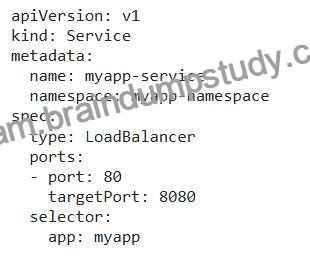
– Configure a Cloud Provider Load Balancer: – Access the load balancer management console of your cloud provider (e.g., AWS Elastic Load Balancer, Google Cloud Load Balancing, Azure Load Balancer). – Create a new load balancer and configure it to listen on the desired port (e.g., port 80). – Configure the load balancer to distribute traffic to the Kubernetes service. This might involve specifying the Kubernetes service’s IP address or hostname, depending on the cloud provider’s setup. – Configure the health check settings to ensure that the load balancer only routes traffic to healthy pods. – Verify Load Balancer Configuration: – Once the cloud provider load balancer is configured, verify that it is working correctly by accessing the load balancer’s public IP address and ensuring that the application responds as expected. – You can also use ‘kubectl describe service myapp-service’ to check the load balancer’s status and external IP address. ,


