Explanation:
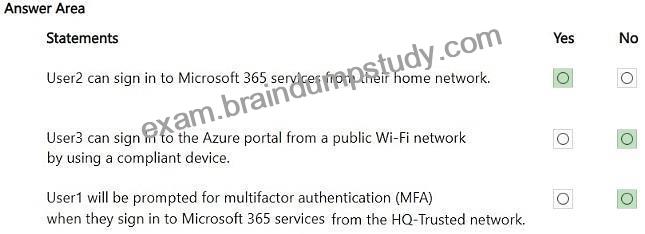
Box 1: Yes
Yes, User2 can sign in to Microsoft 365 services from their home network.
Policy 1 (CA1): Targets “All users” but excludes Group1. Because User2 is in Group2, this policy applies to them. It requires MFA and a compliant device. However, because they are on their home network, they cannot fulfill both requirements simultaneously, and it would ordinarily block them.
Policy 2 (Block Access): Targets “All users” but excludes Group2. Since User2 is a member of Group2, they are completely excluded from this policy.
The Result: Because User2 is not subject to the blocking policy, and the strict device/MFA policy only applies to Group1, User2’s sign-in is allowed.
Box 2: No
No, User3 cannot sign in to the Azure portal.
Policy targeting: The block access policy applies to “All users” and excludes only “Group2”. Since User3 is not in any group, they are included in this policy.
Block takes precedence: The policy applies to “All resources” (which includes the Azure portal) and blocks access.
Public Wi-Fi: User3 is attempting to sign in from a public Wi-Fi network, satisfying the policy’s condition (they are outside the MyTrusted corporate network).
When both block and grant policies exist, the block access policy always wins.
Box 3: No
No, User3 will be blocked from signing in to the Azure portal.
Although User3 is using a compliant device, they do not meet the location condition of the second Conditional Access (CA) policy, which triggers a Block Access. In Microsoft Entra ID, a single block policy will always override any grant controls, no matter what other policies are in place.
Reference:
https://learn.microsoft.com/en-us/entra/identity/conditional-access/what-if-tool


